Mr. Cheong
The VegetarianMr. Cheong is Yeong-hye’s husband and the first-person narrator of the novel’s opening part. He enters the story convinced that a quiet, accommodating marriage will preserve the carefully managed ordinariness he values; when Yeong-hye refuses meat, that arrangement gives way to estrangement and coercion. Later sections disclose his work as a video artist and his marriage to In-hye, widening the portrait of a man whose private images and silences prove as consequential as his outward respectability.
Identity and Background
Mr. Cheong describes himself as someone who prefers the middle course. At school he sought authority over younger pupils rather than risk competing with peers his own age; he chose a college according to the scholarship he could obtain, then took a salaried job at a small company where his modest abilities would be useful. His choices form a consistent strategy: avoid uncertainty, secure a manageable position, and keep disruption at a distance.
That strategy governs how he remembers meeting Yeong-hye. He says he was not attracted to her, and inventories her ordinary appearance, from her plain black shoes and unremarkable walk to her timid, sallow aspect. The absence of conspicuous beauty or talent reassures him: he expects that she will not compare him unfavorably with more impressive men or demand that he perform sophistication. He takes her apparent passivity as a guarantee of ease, and calls their marriage a natural choice precisely because it seems unlikely to unsettle his routine.
The account is his own, and its judgments expose the limits of his understanding. Yeong-hye first appears through his assessments of her usefulness and effect on his comfort; what she wants, beyond her refusal of meat and her resistance to him, is not something he makes room to understand. His matter-of-fact self-description therefore establishes not only his character but also the narrow frame through which the opening part presents her.
Marriage and the Vegetarian Turning Point
Yeong-hye’s change breaks the expectations on which Mr. Cheong’s marriage has rested. After she begins refusing meat, he recalls her saying that she had a dream, and sees her face reflected in the dark window of a subway tunnel as strange and unfamiliar. Even then, his attention returns quickly to work: he has to prepare an excuse for a client, draft a proposal, and confront the prospect of going home early. He acknowledges that in the months since he changed positions he has not once left the office before midnight. The domestic crisis competes with, rather than displaces, his habitual preoccupation with his own schedule.
He does not initially regard Yeong-hye’s condition as an illness requiring consultation or treatment. He tells himself that nothing is wrong and that the situation has nothing to do with him. The distance is deliberate: by treating her behavior as unreal or irrelevant, he can preserve the assumption that their household remains manageable without asking what her refusal means to her.
The widening estrangement becomes especially clear in their home life. Yeong-hye avoids sleeping with him and begins wearing trousers to bed; in the early hours, he finds her lying rigidly awake and staring upward. He considers whether he might get through life by thinking of her as a stranger, a sister, or even a maid who provides meals and keeps the house in order. Those comparisons show him trying to retain the practical benefits of marriage while withdrawing recognition of Yeong-hye as a partner in it.
Coercion and Its Consequences
Mr. Cheong describes forcing sex on Yeong-hye after returning home late and somewhat drunk. He pins her down, overcomes her resistance, and proceeds despite her opposition. The episode is not presented as mutual intimacy: his own account registers her blankness afterward and his uneasy recognition that she seems to have been made to endure an act against her will. He later repeats the assault, finding it easier to do so, but each time experiences ominous unease. The following mornings, her silence and expression trouble his conscience, even as he continues to frame his discomfort around what her face makes him feel.
At the family gathering, Yeong-hye’s father forces meat into her mouth; she spits it out and cuts her wrist. Mr. Cheong is present in the aftermath, while In-hye examines Yeong-hye. He changes into his wife’s husband’s T-shirt and washes blood from himself in an upstairs sauna. He describes feeling disgust, not a new understanding of Yeong-hye. When she is in the hospital, he expects Yeong-ho to take his place at her bedside and looks forward to her discharge less as a return to shared life than as the prospect of again living with someone he finds frightening and strange.
Later, In-hye looks back on the events around Yeong-hye’s hospitalization and judges what Mr. Cheong did to her unforgivable. Her retrospective account also links his treatment of Yeong-hye to the collapse of the lives around her. Mr. Cheong’s own opening narration, by contrast, has shown how readily he makes another person’s suffering secondary to the disturbance it causes him.
In-hye, Art, and the Crisis
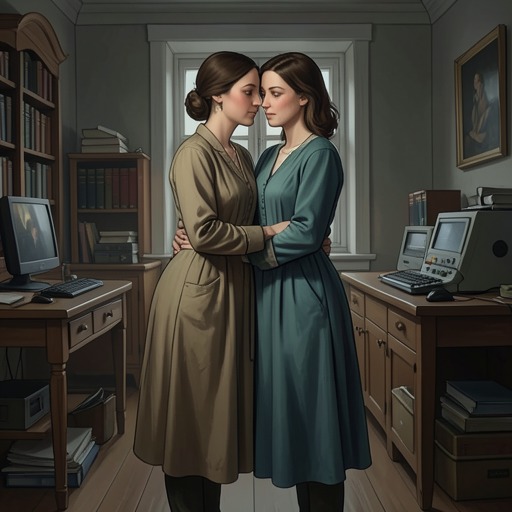
A later change of narrative perspective presents Mr. Cheong through In-hye’s memories. She recalls first meeting him in her shop, where he appeared exhausted, with several days’ stubble and a camcorder bag weighing on his shoulder. He had come in for shaving lotion and leaned on the counter as though he might collapse. His vulnerability drew her toward him, and she wanted to use her strength to give him somewhere to rest. Yet even after marriage he remained absorbed in his own affairs, looking to her more like a traveler temporarily lodged at home than a settled partner. His silence, especially when his art was going badly, seemed resistant to her attempts to reach him.
In-hye had hoped his work might disclose something of his inner life, but she found his video art incomprehensible. She came to wonder whether she had mistaken a wish to help him for a wish to help herself, having recognized her own self-reliance in his apparent exhaustion. This recollection complicates his earlier portrait: the man who seemed unremarkable and dependent to Yeong-hye’s husband was, to In-hye, both a figure of apparent vulnerability and a partner who remained inaccessible.
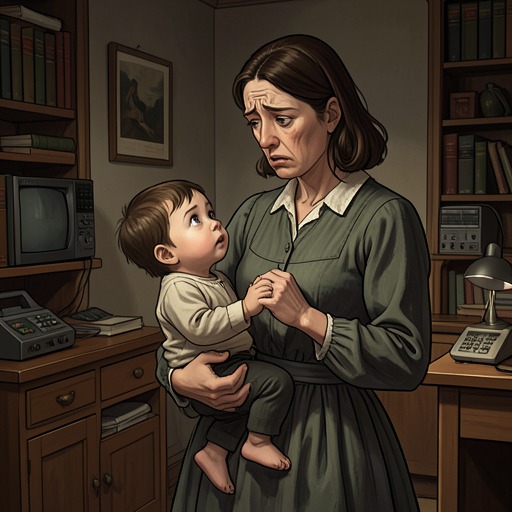
There were moments when his artistic enthusiasm appeared to bridge that distance. A little after Ji-woo’s first birthday, Mr. Cheong filmed the child taking tentative steps in a sunny living room, then being lifted into In-hye’s arms. He excitedly proposed making flowers or butterflies appear beneath Ji-woo’s footsteps and suggested filming again on a lawn. He showed In-hye how to operate the camcorder and played back the footage while talking through his ideas. The scene reveals a capacity for animated involvement that contrasts with the silence and weariness she usually encountered at home.
That artistic life becomes entangled with Yeong-hye. In-hye recalls the bodies of Yeong-hye and Mr. Cheong intertwined and painted with flowers, leaves, and green stems. With time, she understands the images less as simply sexual than as an attempt to shed the human. She wonders whether he staked everything on these strange, desolate images and lost everything. Her account does not make his artistic project an excuse for the harm surrounding it; instead, it places his image-making beside the intimate and familial consequences that he cannot control.
Separation and Narrative Significance
In-hye remembers that Mr. Cheong called her once, close to midnight, around nine months earlier. He asked to see Ji-woo, struggling to sound composed, but did not apologize or ask after Yeong-hye. The call makes the remnants of his family life concrete: his stated concern is access to the child, while In-hye registers what he leaves unsaid. The narrative offers no reconciliation in this exchange.
Mr. Cheong is drawn chiefly through other people’s accounts as well as his own: the opening first-person voice displays his self-protective calculations, while In-hye’s later perspective reveals his silence, his work, and the damage that his actions leave behind. That shift matters because it exposes the distance between the orderly marriage he thought he had chosen and the experiences of the women around him. His narrative role is not simply that of a husband unsettled by Yeong-hye’s refusal of meat. He is also a measure of how ordinary expectations—of a convenient wife, a functioning household, and a life free of disruption—can coexist with failures of recognition and acts of coercion.